It’s curious. I prefer heat to cold, but struggle with really high temperatures and humidity. I don’t tolerate spicy food very well–having grown up on basic midwestern fare. I love the land I’m living in – the depth and breadth and quiet of Montana’s sky and landscape. I’m old. Getting out of Montana to far-away places requires expensive and wearying travel.
So why India? Why India twice—and counting!
Let me try to untangle the strings that pull me to India. Note the word “try.” I’m still grappling with the question myself!
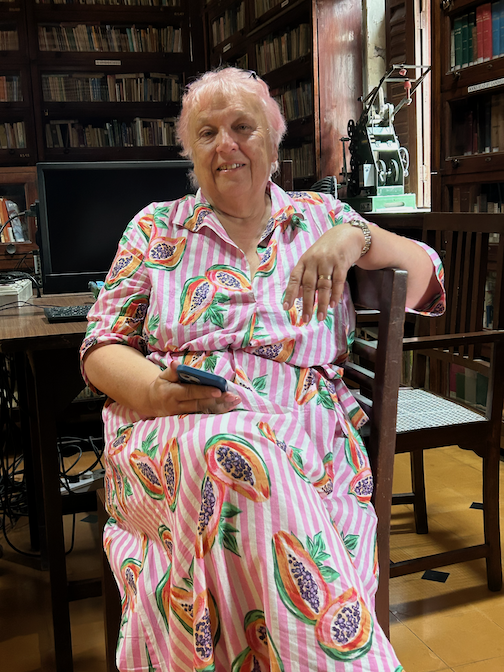
The first is Helen—who has lived in India; actively supports an Indian NGO for women, children, and older people facing trauma; and owns a shop in the UK selling Indian goods. Not exactly a guide for hire, Helen loves reasons to spend time in India—and sometimes invites a few friends along. The opportunity to learn from and travel with someone who loves the people and the place is incredibly compelling. And through Jean and Bryan, I’d learned to know Helen and she, me. Helen opened the door to the very possibility.
Second, there was a book. Well, really, there are many great books about India, past and present. But one in particular set me to wanting what—at that time–seemed like the improbable opportunity–to go to India: City of Joy by Dominique Lapierre. A novel, but based on lived experience and interviews, the book describes life in the poorest neighborhood of Calcutta where the author found love and community and acceptance, vibrant life and horrific sacrifice. Reading it, I peered into a world where people lived more immediately, more fully, more intensely—often at great cost—than any living I’d known.
Then there was a second book, Shantaram By Gregory David Roberts, also part autobiography. Darker still, the framework matched Lapiere’s portrayal of life lived fiercely, ingeniously at whatever the cost.
A year ago, I arrived by myself in the Mumbai airport at two in the morning. And was driven to our hotel by a Travel Counselors’ (a worldwide travel company) staffer and a driver. Through Mumbai’s dark streets still teeming with snarled traffic, an accident, and an ambulance stalled in the crush of vehicles. City of Joy and Shantaram came alive. And India became a reality.
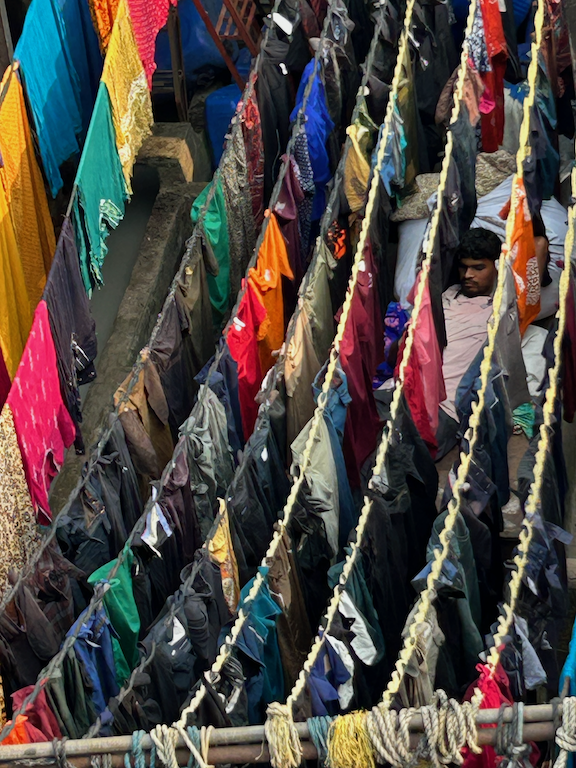
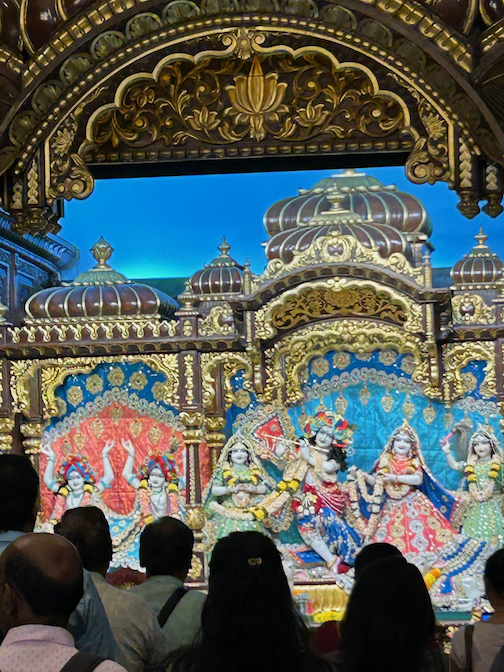
Our day’s tour of Mumbai included a museum, the dhobi ghats (as I had to learn “dhobi” means laundry; “ghats” are steps leading to water) a Hindu temple, a house where Gandhi stayed, the Hanging Gardens, the Tower of Silence, and quick looks at the Gateway to India, the Taj Hotel, Marine Drive, Leopold Café, walkways of art. And everywhere—everywhere—streets packed with rickshaws, cars, motorcycles, buses, and lorries—every last one of them honking to protect their roadway space. I didn’t feel overwhelmed or tired. I was high on the energy. Exhilarated by the sheer volume of human activity and the seeming symbiosis among all the humans.*
As we traveled south of Mumbai to Panji and Kochi and the backwaters of Kerala on to Trivandrum, the bustle continued—not always as frenetic as Mumbai but still impossibly crazy by any Montana standard. Plus there were major “flyovers” and warehouses and tower blocks under construction; always lines of shops and houses—modest, falling-down, and shiny brand-new—intermingled, side by side. So many commercial enterprises that I couldn’t fathom how there were enough shoppers to constitute a living. I began what will be a forever-process of coming to terms with so many people—so many people engaged in every element of life.
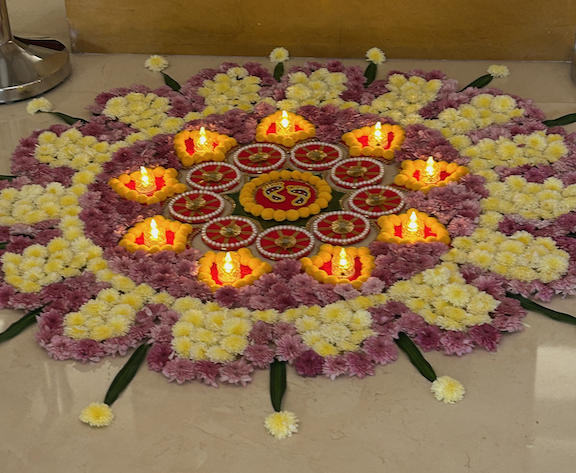
That first year, we were there for Diwali, the Hindu, Sikh, and Jain festival celebrating the spiritual victory or triumph of light over darkness, good over evil, and knowledge over ignorance. The Indian landscape was alight with carts of marigolds and swooping marigold strings over doorways; with little tea or oil lights arranged in rangoli patterns on floors and tabletops. And with fireworks. The Raj Hotel, where we had high tea, shimmered with enormous flower displays. I began to “feel” color, to revel in that immersion.

I found color even more engrossing in this second trip through Rajasthan—high desert country that flaunted the brightest, radiant hues. Not gentle pastels—but screaming ones. Not subdued beige—but gold inlaid with patterns. And intense reds and blues, azures and greens many rimmed by gold. Fruit stands, saris, turbans, rickshaws, paintings, lights, trucks/lorries, signs, fabric, doorways, flags. Huge patterns, block prints, deep solids, intricate artwork. Yes, servers and room attendants wore crisp black and white. But they worked in worlds of color – hotel lobbies draped in bright fabric and flowers. I feasted on color.

Helen points out that much of my fascination with India likely lies simply in its incredible newness—divergence—difference–from anything I’ve known before. And that’s true. So far from my sparsely-populated, colder, northern Montana world—that has witnessed Euro-Americans for maybe 300 years. And has short-changed our much older native inhabitants in every possible way. The timelines and architecture and music and politics and artistries of the United States and of Europe—the fodder on which my reading of history has concentrated—bears no resemblance to those of India. And what tiny dabblings with world history that I’ve experienced, never never brought me face-to-face with the sub-continent. Once I started reading (and I quickly leapt beyond City of Joy), I could only begin to comprehend the trade, religious, political, cultural, artistic layers upon which Indian culture is built. Those layers and that can-do creativity remain vibrant now.
It’s also no small matter that my travels through India have been with interesting, easy-to-be-with companions. Great conversationalists and thoughtful travelers. In addition to Helen and Jenny, Pippa and Davina on the first trip.
But we’re still not all the way there yet. To why India captivates me so. And along the way, I’ve discovered thoughts and words that are far more apt and eloquent than mine to explain myself. I’m turning to Mark Twain. In a fit of ennui and financial desperation, Mark Twain and his wife and daughter Clara (plus what we’d call handlers)–circled the globe in 1896 and 1897. Twain wrote a travelogue about the journey: Following the Equator. Of all the places they visited, India fascinated Twain the most. And stumbling into his 120 year-old descriptions brought me home to my gut:
“This is indeed India. . . . The land of dreams and romance, of fabulous wealth and fabulous poverty, of splendour and rags, of palaces and hovels, of famine and pestilence, of genii and giants and Aladdin lamps, of tigers and elephants, the cobra and the jungle, the country of hundred nations and a hundred tongues, of a thousand religions and two million gods, cradle of the human race, birthplace of human speech, mother of history, grandmother of legend, great-grandmother of traditions, whose yesterday’s bear date with the moldering antiquities for the rest of nations-the one sole country under the sun that is endowed with an imperishable interest for alien prince and alien peasant, for lettered and ignorant, wise and fool, rich and poor, bond and free, the one land that all men desire to see, and having seen once, by even a glimpse, would not give that glimpse for the shows of all the rest of the world combined.”
And then this, which felt even more real:
“India was as near to life and death as it was possible to be on earth, but it was not one or the other. Here was life in death and death in life.”

Yes, in addition to all the kind people, the successful businessmen, the color, the layers-deep artistry that I experienced in India, I was struck by how raw and immediate and compelling—and often tenuous–life is there. City of Joy and Shantaram laid out in front of me—the world I so wanted to see. The primacy of each individual day—and what was possible in that day. We witnessed a funeral procession in Jaipur. In Mumbai, we stood close to the Tower of Silence, once the Zoroastrian platform where human dead were laid for carrion birds. We passed a bloated cow carcass—feet up in the air–as well as dozens of live cows, living cheek by jowl with humans and traffic. In Udaipur, we watched a protest of young men—likely in sympathy to the Cockroach Party’s protests in Delhi against Prime Minister Modi election-meddling. We hugged a smiling, toothless elder on our way to the block-printing shed—she reached out for our hands and faces. We came to recognize the building in Jaipur where street people are fed. We were hustled by children—at the mercy of the gangs that “care” for them, as we waited in traffic. And I was hustled no less enthusiastically or skillfully by a jeweler and a business owner trading in antiquities. We were welcomed into Ajay and Divvya’s and Amit and Anjali’s homes–joyfully, warmly, unselfconsciously—even as almost strangers. And throughout both trips, I exchanged more smiles with more people than ever happens here. Life celebrated and invested; opportunities seized; death accepted as part of life.

Helen reminds me not to view India through rose-colored glasses. To remember—as does Twain—that this country with fabulous wealth and energy—that this country with incredible energy and creativity—also leaves many many people far behind. In deepest poverty, hunger, illness, danger, and pain. That India has its share of selfish billionaires and corrupt politicians and horrid government choices and despicable corporate behavior. I work to remember. And use water as a powerful, moment-to-moment reminder of the gifts in my world. And of the almost unfixable quandaries in India. When I turn on my faucets here, I am met with safe, sweet water. A luxury in India.
Let me come back to the City of Joy and the world it laid at my feet, so vividly that I wanted to travel there. Stephan Kovalski, a young Polish priest, one of the stories’ central characters, desperately wants India to be the site of his mission work:
“India! A subcontinent with exceptional potential wealth—yet where areas and social groups of overwhelming poverty survived. A land of intense spirituality and of savage racial, political, and religious conflicts. A land of saints. . . and of political leaders who were sometimes odiously corrupt. A land that manufactured rockets and satellites but where eight out of ten of its inhabitants had never traveled faster than their oxen could pull their carts. A land of incomparable beauty and variety, and of hideous prospects like the slums of Bombay or Calcutta. A land where the sublime often stood side by side with the very worst the world can offer, but where both elements were aways more vibrant, more human, and ultimately more attracting than anywhere else.”
And Kovalski finds this when he arrives in Anand Nagar, this poorest of Calcutta neighborhoods, where he intends to live:
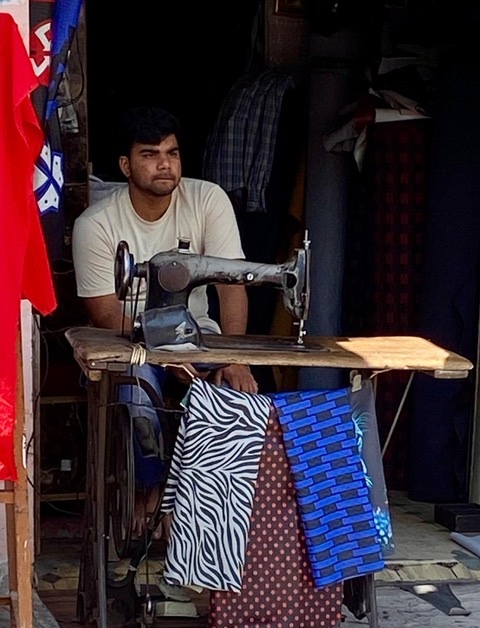
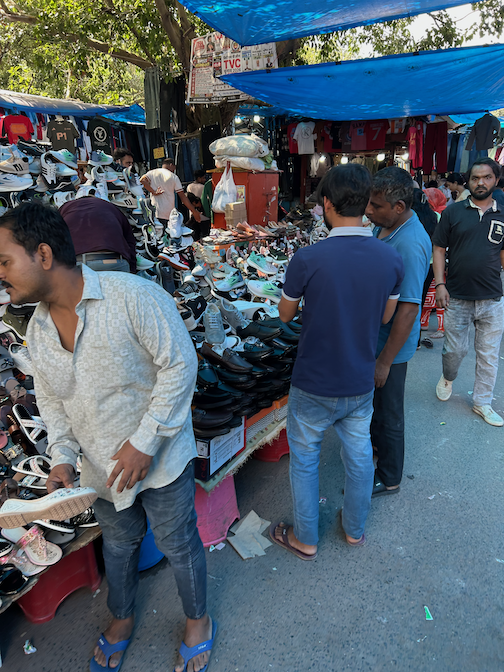
“Every single one of them from the most worn-out old man to children hardly yet able to walk was busy with some task. Everywhere, on the doorstep to each hut, at the foot of every stall, in a succession of little workshop or minifactories, Kovalski discovered people industriously selling, trading, manufacturing, tinkering, repairing, sorting, cleaning nailing, gluing, piercing, carrying, pulling, and pushing. After six hundred feet of exploration, he felt as if he were drunk.”
So once more—why? Why India?

Because there’s that intricate, vigorous, colorful, pulsing life—and death–on the knife-edge of every day. Lived with eyes wide open to that day’s and each other’s possibilities. ©
*Montana “boasts” about 8 people per square mile. Mumbai’s greater urban area contains roughly 60,000 per square mile for a total of 20 million people.
Many of the best photos are Helen’s!
